Showing posts with label Vintage Ham Radio. Show all posts

December 31, 2018

A magical morning with SAQ Grimeton Radio

Last edited:

I've been a radio enthusiast since the early 1980s, but it wasn't until recently that I finally got myself a receiver and antenna suitable for listening to VLF (3-30 kHz) (see my earlier blog posting here).

One of my goals with the new VLF setup was to receive one of the special CW transmissions on 17.2 kHz from historical radio station SAQ Grimeton in Sweden.

Grimeton Radio was built during the years 1922-1924 to provide a "longwave" wireless telegraphy transmitting and receiving station for transatlantic telegram traffic with the United States. The first transmitter used was a VLF machine transmitter invented and designed by Swedish engineer Ernst Alexanderson. Grimeton Radio went on the air in December 1924 with the callsign SAQ. Initially transmissions were done on the frequency of 16.1 kHz but this was soon changed to 17.2 kHz.


The Alexanderson alternator transmitter at Grimeton Radio (source)

After some years, new technology had made the Alexanderson machine transmitter obsolete for its original purpose; by the 1930s transatlantic communication had gradually started to switch to shortwave, and vacuum tube shortwave transmitters were used instead.  The Alexanderson transmitter was still used however to communicate on VLF with submerged submarines, and wasn't  decommissioned until the 1990s. Luckily the complete site of Grimeton Radio, including the original VLF machine transmitter, has been preserved as a historical monument. In 2004 the radio station was added to UNESCO's List of World Heritage Sites.

Like mentioned earlier, the original VLF machine transmitter at Grimeton Radio was designed by Swedish engineer Ernst Alexanderson. It consisted of an alternating-current generator (the so called Alexanderson alternator) driven by an electrical motor through a speed-increasing gearbox. When driven at high speed at the correct RPM, the alternator generates a signal on 17.2 kHz. Yes, this means that RF is generated without any electronic parts (like tubes or transistors) involved at all!
Although not in regular use anymore, two or three times a year on special days a CW message is transmitted by Grimeton Radio using this very same historical Alexanderson alternator transmitter!

Traditionally, one of the special transmissions is done in the morning of Christmas Eve, and so was the case this year. And I was extremely happy to manage to catch it! For the first time I was listening to this special station, to a Morse Code transmission generated by a historical, pre-electronic transmitter, the only one of its kind remaining! And on one of the most beautiful and magical days of the year! Goose bumps!

Grimeton Radion at  - 6ºC on the morning of Christmas Eve 2018 (source)

The signals were picked up at PA7MDJ with an SDRPlay RSP1A receiver and a MegActiv MA305FT E-field probe antenna. Below on my SoundCloud account you can listen to the recording I made this beautiful Christmas Eve morning, December 24th, 2018.

The transcript of the received Morse Code message reads as follows:

CQ CQ CQ DE SAQ SAQ SAQ =
THIS IS GRIMETON RADIO / SAQ
IN A TRANSMISSION USING THE ALEXANDERSON 200 KW ALTERNATOR
ON 17.2 KHZ =
WE WISH YOU ALL A MERRY CHRISTMAS AND A HAPPY NEW YEAR =
SIGNED: THE WORLD HERITAGE AT GRIMETON
AND THE ALEXANDER-GRIMETON VETERANRADIOS VAENNER ASSOCIATION AR =
FOR QSL INFO PLEASE READ OUR WEBSITE:
WWW.ALEXANDER.N.SE II WWW.ALEXANDER.N.SE =
DE SAQ SAQ SAQ SK

The message was preceded by a "VVV VVV VVV DE SAQ SAQ SAQ" loop.

In 2003 I visited the Grimeton Radio site to look for a geocache (one of my other hobbies), unfortunately without the possibility to take a look inside the transmitter building, but that's another story.


See also:

https://www.youtube.com/watch?time_continue=2719&v=shqi43EV07c  - Video made at Grimeton Radio during the special Christmas Eve 2018 transmission
https://alexander.n.se/?lang=en
https://en.wikipedia.org/wiki/Grimeton_Radio_Station
http://whc.unesco.org/en/list/1134

November 08, 2018

The National NC-183D receiver - You can't log 'em if you can't hear 'em!

Last edited: 02.01.2019


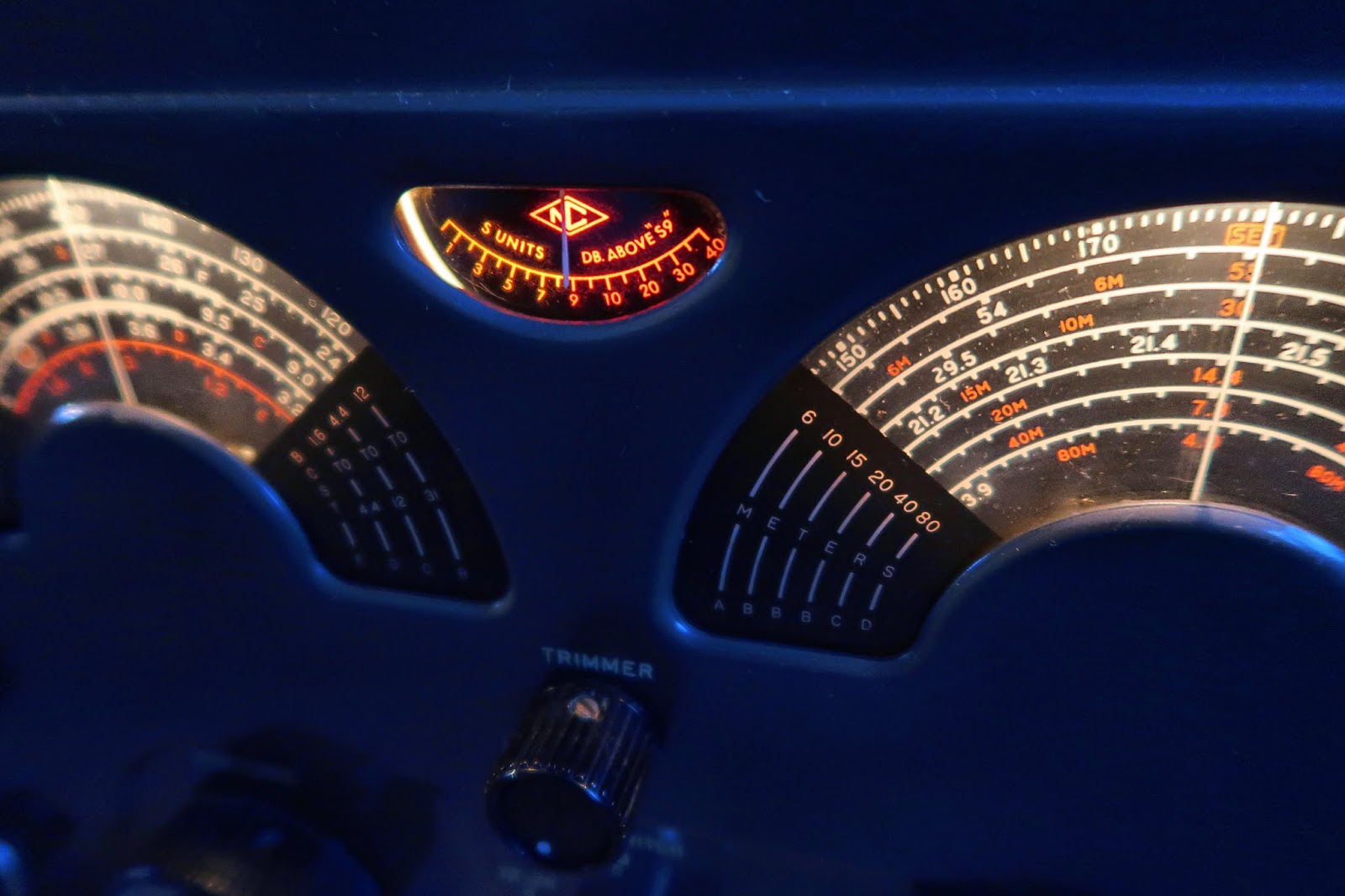
On October 27th I set out on a long car trip to the southern part of the Netherlands, to Roermond, to pick up this old beauty that I had bought at an online marketplace site. It's a National NC-183D general coverage / amateur band receiver from the 1950s. It's in perfect condition, both cosmetically and technically. Listening to the NC-183D is such a treat; CW, SSB, but especially the full and warm sound of AM broadcast stations! The AM sound is exceptionally good, and I believe no modern amateur receiver will ever be able to match it. The whole experience of using this old radio, visually, auditory, olfactory, to me it brings back the magic I felt when I started out as a radio hobbyist as a young teenager in the early 1980s. Finding a NC-183D outside of the United States is not a very common occasion.
 

I'm a sucker for old amateur rigs and communication receivers, but mostly I can resist the urge to buy them (so far I had been able to keep the collection constrained to a Yaesu FTdx-100 transceiver and a Signal Corps BC-312-M receiver). But this one I really had to have. The predecessor of this particular model, the National NC-173, which in appearance is almost identical to the NC-183D, was used in 1947 by the two radiomen aboard the balsa raft of Thor Heyerdahl's legendary Kon-Tiki expedition across the Pacific. The photos and film footage I've seen of this radio in use aboard the raft had left an unerasable impression! See also my blog entry about amateur radio aboard the Kon-Tiki raft here.
 

With its 30 Kg the NC-183D definitely fits in the category "boat anchors" which vintage radio enthusiasts often affectionately like to call their old radios.The NC-183ND was manufactured by the National Company Inc. of Malden, Massachusetts, USA between 1952 and 1959. The radio's new price was about US$ 380, which at the time was about one fifth the price of a new car! 

I have some old QST magazines from the 1950s in my collection, and one of them (the October 1953 issue) contained this wonderful National advertisement for the NC-183D shown in the pictures below. Coincidentally this issue on page 31 also contains an article on "How To Tune S.S.B. on Any Receiver". SSB was a novelty in those days, and even though a receiver was equipped with a BFO for CW reception, getting a clear, intelligible SSB signal from the radios of this era wasn't as straightforward. As I found out with the NC-183D, and as suggested by the QST article, turning down the RF Gain does the trick!

Imagine the signals this radio might have picked up during its lifespan! Did it pick up the signals of the Sputnik-1 in 1957*? Did its owner listen to broadcast stations playing the first Rock and Roll songs? Did it hear amateur signals from countries that no longer exist? From countries across the Iron Curtain? The NC-183D grew up during an exciting time in world history, just imagine the endless possibilities of exciting signals this radio might have picked up....


Below you'll find a list of selected links to webpages containing more information about the National NC-183D. More will be added over time.

"You can't log 'em if you can't hear 'em! No matter what else a receiver does, it must pull ém in! And that's just what the NC-183D does!" is how National in 1953 advertised the radio, and amazingly this one after more than 60 years still does!

*The Sputnik-1 was the world's first artificial satellite. It was put in space by the Soviet Union and signalled the start of the "space race" between the US and the USSR. The Sputnik-1 transmitted a 1 Watt signal on 20.005 and 40.002 MHz. It could be easily picked up by amateur radio operators around the world. Even the US time signal station WWV halted its 20 MHz nighttime broadcasts to avoid interference to the Sputnik signal! Some more interesting links can be found below.


See also:

https://people.ohio.edu/postr/bapix/NC-183D.htm
https://www.eham.net/reviews/detail/4423
https://www.radiomuseum.org/r/national_nc_183dnc183.html
http://bama.edebris.com/manuals/national/nc183d/
http://jvgavila.com/nc183d.htm
https://www.prismnet.com/~nielw/nat_list/nc183d.htm
http://www.radioing.com/museum/rx5.html

https://en.wikipedia.org/wiki/Sputnik_1
http://www.pe0sat.vgnet.nl/satellite/russian-satellites/
http://www.arrl.org/news/remembering-the-launch-of-sputnik-1-earth-s-first-artificial-satellite
http://mentallandscape.com/S_Sputnik1.htm

June 01, 2017

Amateur Radio in the Autonomous Monastic State of the Holy Mountain

Last edited: 06.06.2017

Latest news 02.06.2017 - Apparently George Vlachopoulos SV1RP during the WPX Contest was not active from Mount Athos but from his "alternative shack" in Giannitsa in northern Greece. Read more in my blog entry of June 2nd, 2017.

Last weekend during the CQ World Wide WPX CW contest, I finally managed to make my first ever contact with Mount Athos! Ok, "sort of", as you will read later on.

Mount Athos forms a separate DXCC entity, and let me tell you, it won't be easy to find one that's more mysterious, mystical, magical, obscure, and controversial! Mount Athos is a mountainous peninsula in northeastern Greece stretching out for about 50 km into the Aegean Sea, its width varying between 7 and 12 km, and its highest point reaching about 2,000 m. Although land-linked, the isolated, rugged region is practically only accessible by boat. Spread out over the peninsula are 20 Eastern Orthodox monasteries. Alhough considered part of Greece, Mount Athos is a self-governed, autonomous region, known officially as the Autonomous Monastic State of the Holy Mountain. It's commonly referred to simply as the "Holy Mountain", or "Agion Oros" in Greek. Mount Athos is governed by the "Holy Community" which consists of the representatives of the 20 Holy Monasteries.

Map of Mount Athos showing the locations of the 20 monasteries. Click to enlarge. (source)
Part of Mount Athos peninsula seen from the air (source)
Travelling to Mount Athos is like travelling back in time; for over 1,000 years, practically nothing has changed in the "Garden of Virgin Mary" as the Monks call the territory. The monasteries of Mount Athos were founded many centuries ago, some of them have a history going back even more than a 1,000 years, and many of them are fortified with thick walls and towers that had to keep pirates at bay. Mount Athos still is on the Julian calender, which means their date runs thirteen days behind to that of the rest of the world. The number of daily visitors is restricted, and a special limited-period access permit has to be obtained before entering the Monastic State. Visitors have to abide by a dress code and rules including not smoking. Women and children are not allowed to enter the territory at all, and even female animals are banned from the mountain (except for female insects, female songbirds, and female cats)!

One of the 20 monasteries of Mount Athos. About 2,000 monks call Mount Athos their home. (source)
Another Mount Athos monastry. A list of all monasteries and photos of them can be found on Wikipedia. (source)
Of course a contact with such a unique DXCC entity has always been much sought after by ham radio operators around the world. Luckily, since a couple of decades, Mount Athos has had its own resident amateur radio operator, the famous Monk Apollo SV2ASP/A, operating from the Docheiariou monastery. This is quite a unique situation for such a small and special DXCC entity!
Monk Apollo first came in contact with amateur radio in the middle of the 1980s when his monastery had remained without telephone for over five months and during which a medical emergency occured. When a doctor heard the story, being a radio amateur himself, he suggested somebody at the monastery would become a radio amateur operator, in order to guarantee continued communications during an emergency.
By the end of the 1980s Monk Apollo had obtained his amateur radio licence. But the working days at the monasteries of Mount Athos are long and hard, Monk Apollo's free time is scarce, and his time spent on amateur radio is little. The chances of catching and working Monk Apollo on one of the ham bands are quite slim.
So, not surprising, for many years radio hams have been trying to set up DXpeditions to the Holy Mountain to activate the much sought after entity on the ham bands. In the past, a group of Greek radio amateurs with the help of Monk Apollo were granted permission, but all applications thereafter by other radio amateurs were denied. There have been some hams operating from Mount Athos however, but their operations were "secret" and declared illegal by Monk Apollo and the Holy Community, as there might have been permission from one of the monasteries, but not from the Holy Community! According to Greek law, to operate a ham station from Mount Athos, a written permission is needed from the Mount Athos Holy Community.

Monk Apollo, SV2ASP/A (source)
Of the various hams that were operating from Mount Athos "illegally", the most notorious probably is DXpeditioner Baldur Drobnica DJ6SI. Just Google for DJ6SI and Mount Athos and you'll find plenty more on this particular episode of the Mount Athos ham radio history. Although the operation of DJ6SI from Mount Athos in 1991 was declared illegal by Monk Apollo, it did get DXCC validated!
In May of 2015 a group of Latvian hams were on their way to Mount Athos to get on the air from the Monastic State as SV2/YL7A. They claimed to have received oral permission for their ham radio activities from one of the monasteries. The group had permits to enter the Monastic State as pilgrims, but as soon as Monk Apollo and the Holy Community found out about their real intentions, access to Mount Athos was denied, the group had to return home, and the DXpedition was cancelled.

QSL card from the controversial SY/DJ6SI DXpedition of Baldur Drobnica (source)
The latest episode in the history of "illegal" ham radio operation on Mount Athos is the one of Greek radio amateur George Vlachopoulos SV1RP which back in June 2015 operated from the Koutloumousiou monestary using the callsign SV2/SV1RP/A (1) and SV2/SV1RP/T. The /A is usually added when an amateur station is operated from an alternative location, but here is added as it traditionally has been for operations from Mount Athos. The /T stands for "Training". According to Greek law, under supervision of a licenced ham operator, and with the /T added to his callsign, people without a ham licence are allowed to use his ham radio station for training purposes. Vlachopoulos claimed to have been legally operating from Mount Athos training several of the resident monks in amateur radio practice, most noticeably Monk Iakovos who as a result in 2015 obtained his amateur radio licence and has been operating from Mount Athos since with the callsign SV2RSG (No /A added, read the story on his qrz.com page). Monk Iakovos is a permanent resident of the Koutloumousiou Monestary. Vlachopoulos claimed he was in the possession of official documents which should give the operation DXCC approval, but as far as I know, both him and Monk Iakovis so far seem to have failed in getting DXCC validation.

Monk Iakovis is presented his radio amateur licence in the presence of the Koutloumousiou Monastery abbot and George Vlachopoulous, SV1RP (first from the right) (source)
My contact this weekend was with SV2/SV1RP/A on 20m CW. So it seems George Vlachopoulos again has travelled to Mount Athos. At this time I don't have all the details on the operation, but it's reported on the DX World site that Vlachopoulos again was active from the Koutloumousiou Monestary, from which he also got permission for the operation again. I'm curious how the story will unfold this time, but I bet this is another "secret" operation without the authorization of the Holy Council. At the moment I made the contact, I was unaware of the "troubled" ham radio history of Mount Athos, which I first learned about when doing research for this blog entry. Also I was under the impression I was working a 100% legal Mount Athos activation. The contact most likely will not give me DXCC credit for Mount Athos, but my signals were there, in that magical place (just look at the photos!), I made contact with one of Mount Athos' monasteries, and I'm thrilled about it!

Olive trees at Koutloumousiou Monastery, the QTH of SV2/SV1RP/A (source)
After the "illegal" operation on Mount Athos of DJ6SI, now more than two decades ago, and other ham operators which, in the words of Monk Apollo, "tried to fool the Monks", the Holy Council and Monk Apollo still seem to hold a grudge, and all applications for amateur radio activities from Mount Athos are structurally denied. Some accuse Monk Apollo of swinging a big hammer in the Holy Community Council and at the DXCC desk, and say he has built for himself on Mount Athos an amateur radio monopoly which he tries to protect.
But Mount Athos is more than just a much coveted, exotic DXCC entity alone. It's also a sanctuary of peace, a sacred place, a different world where time stood still, a home where Monks lead a simple life, away from the hectic, modern, and complicated lifes most of us live today. And such a place is fragile, and maybe that's the only thing Monk Apollo is trying to protect.
What puzzles me though is that resident Monk Iakovos still hasn't managed to obtain the required documents for DXCC approval, but I don't know the whole story here, and thus for now I'll have to refrain on any further comments on it.

The attitude of the Holy Community and Monk Apollo towards guest ham operators, with which they've practically closed the DXCC entity to non-resident ham operations, and the resulting voices raised by some in the ham community to therefore better delete Mount Athos as a DXCC entity, lead to some controversy of which good examples can be found in the discussion threads on eHam as linked to below. There's also much info on the activations of DJ6SI and SV1RP in there.

I for sure hope Mount Athos will never be deleted from the DXCC list, and hopefully with some luck and a lot of DX Cluster watching, I'll someday get the chance to work the elusive Monk Apollo himself. And to be honest, I wouldn't like to see it any other way; some places should remain shrouded in mystery, some places on the ham bands should remain shrouded in elusiveness.

You can listen to a recording of my contact with SV2/SV1RP/A below.


Addendum 06.06.2017
(1) I'm not sure but I believe the SV2/SV1RP/A callsign in 2015 never was used on the air, only the SV2/SV1RP/T callsign. Vlachopoulos' 2015 QSL card does mention the /A though.

QSL card SV2/SV1RP/A/T (source)

See also:

https://en.wikipedia.org/wiki/Mount_Athos
http://www.ouranoupoli.com/athos/athos.html
http://www.dailymail.co.uk/travel/travel_news/article-3385149/The-striking-images-Mount-Athos-Greece-women-children-banned-female-animals-forbidden.html
http://www.eham.net/ehamforum/smf/index.php/topic,103726.0.html
http://www.eham.net/ehamforum/smf/index.php/topic,84717.0.html
http://www.eham.net/ehamforum/smf/index.php/topic,104465.0.html
http://www.qsl.net/sv2tx/athos_dxpedition.html
http://herc-hastings.org.uk/the-story-behind-the-card-series-2-no-1-mount-athos/
http://hamgallery.com/qsl/country/MountAthos/dj6si.htm
https://n6pse.wordpress.com/2014/11/27/interview-with-baldur-drobnica-dj6si/
https://n6pse.wordpress.com/2014/08/08/a-conversation-with-monk-apollo-sv2aspa/
https://dx-world.net/a-reponse-from-monk-apollo-sv2asp-a/
http://qrznow.com/sv2aspa-the-position-of-the-holy-community-of-mount-athos-for-amateur-radio-emissions-from-athos/
https://dx-world.net/sv2-yl7a-mt-athos/
https://dxnews.com/sv2yl7a-mount-athos/
https://dx-world.net/sv2-sv1rp-a-mt-athos/
http://www.n0un.net/sv2-sv1rp-a-mt-athos-on-the-air/
http://www.dxcoffee.com/eng/2015/sv2sv1rpt-mount-athos/
http://www.southgatearc.org/news/2016/april/new_ham_at_mount_athos.htm#.WS87yrjSk1J

May 20, 2017

JA1MP

Last edited:

No extensive blog entry this time. I just wanted to share this 1965 CQ Ham Radio cover. To me, this is one of the most iconic photos in ham radio. It shows Sako Hasegawa JA1MP (sk) founder of Yaesu Musen Co. Ltd at the dials of a Yaesu FL-200B transmitter and a FR-100B receiver. 


April 28, 2017

How the world learned about the Falklands War

Last edited:

Penguins on the Falkland Islands. Land mines placed by the Argentines are still present today (source)
The Falklands War was a ten-week war between Argentina and the United Kingdom over two of the British Overseas Territories in the South Atlantic: the Falkland Islands and South Georgia and the South Sandwich Islands. It began on April 2, 1982 when Argentina invaded and occupied the Falkland Islands in an attempt to establish the sovereignty they had claimed over the islands. The invasion had caught prime minister Thatcher by surprise, and even though the war was short, it turned out to be a deadly one.
I was still at a very young age but I remember it very well. It was probably the first time I heard about the existence of the Falkland Islands. I have been fascinated by the archipelago ever since, for its geographical location, for its remoteness, for its subantarctic character and rugged nature, and for the major role the islands play in the operations of the British Antarctic Survey.

In March of 2014, then still with my novice licence and PD7MDJ callsign, on 10m SSB, I managed to work Bob McLeod VP8LP located in Stanley, the capital of the Falkland Islands. It was my first contact with the Falkland Islands, and I was ecstatic! You can listen to a recording of the contact here at my SoundCloud page.

I didn't know then about the major role Bob McLeod had played at the beginning of the war as the only news source on the Falkland Islands, as the only link with the outside world. It was Bob McLeod who with his ham equipment first confirmed that the Falkland Islands had been taken over by Argentina, and who via ham radio provided BBC journalist and fellow ham operator Laurie Margolis G3UML in the UK with the scoop. Margolis broke the news on the BBC Radio 4 PM programme that same day. The fascinating story, as found on the BBC News site, can be read below, or you can find the original article on http://news.bbc.co.uk/2/hi/uk_news/6514011.stm.

Stanley, Falkland Islands (source)
There seems to be circulating on the internet a tape recording of the radio communications during the war of VP8LP with the UK. According to this forum http://www.shipsnostalgia.com/showthread.php?t=96066, the recording here is a recording of the actual QSOs with Bob McLeod on April 2nd, 1982, the day of the invasion. Intelligibility is poor at times, unfortunately.

My radio friend Alan from the UK told me he remembers during the conflict that the UK Government contacted all UK hams and gave them a phone number to call if they heard Bob or any other Falklands hams on the air. He also told me that during the war the UK Government had set up a broadcast station on Ascension Island to broadcast to the area, because the BBC World Service wouldn't allow itself to be used for any propaganda purposes in case this affected its reputation for impartiality. The Media Network programme with Jonathan Marks did a feature about Radio Atlantico del Sur, as the station was called, which can be found here in the Media Network Vintage Vault.

The Falkland Islands is IOTA SA-002 and forms a separate DXCC entity. Bob McLeod's wife Janet McLeod also is a ham operator and holds callsign VP8AIB. I managed to work her in late 2014 with the special callsign VP8AIB/100, commemorating the WWI Battle of the Falklands.
---
How BBC man scooped invasion news
By Laurie Margolis
BBC News (April 2, 2007)

Walk down London's Portland Place, heading south from Regent's Park towards Regent Street,and you come to a kink in the wide road.

Immediately ahead of you is the plush Langham Hotel, very expensive and also one of the most haunted buildings in London.

To your left, BBC Radio's headquarters at Broadcasting House. This busy location, on the northern edge of London's West End, was the focus of the way the story of the Falklands invasion unfolded exactly 25 years ago.

Back in 1982 I was a BBC journalist and also an amateur radio operator - I still am. That means I have a call-sign - G3UML - and some expertise in long-distance short-wave communications.

At the very end of March, 1982, I was working on the Golan Heights, hearing on the BBC World Service a bizarre story about Argentine scrap metal merchants taking over the British dependency of South Georgia.

Invasion claim

I returned to London on the morning on 2 April, and went into Broadcasting House to work on a documentary. I was met by scenes of near panic in the radio newsroom.

The Argentines were claiming to have invaded and taken over the Falkland Islands, the 2,000-strong British colony off the south-eastern tip of South America.

Argentine soldiers took control after a few hours' resistance

The newsroom had Argentine claims, but nothing else apart from a laconic message from the Cable and Wireless station on the Falklands - "we have a lot of new friends".

At that time the Langham Hotel was a dreary BBC office block and, in a dusty, junk-filled attic room - number 701 - the BBC's own amateur radio club had a shortwave transceiver. With a big aerial on the roof, it worked pretty well.

My senior editors wondered if there was any way I could contact the Falklands through amateur radio. Nothing else was working. It seemed a possibility. The remote nature of the islands meant that radio was important, and for the small population there were a lot of radio amateurs down there.

'A true scoop'

So I took up a vigil in room 701, listening carefully across the 14, 21 and 28 megahertz bands for anything from VP8 - the international call-sign prefix for the islands.

And about six hours later, I struck gold. On 21.205 megahertz at 1600 London time, that rather distinctive accent, a bit West Country - a Falkland Islander.

And what a story he had to tell - a true scoop, an exclusive of the greatest magnitude.

The voice was that of Bob McLeod, and he lived in the settlement of Goose Green on East Falkland. His call-sign, I realised, was VP8LP but he was anxious that it shouldn't be used. I have much of what he said that day recorded on an old-fashioned audio cassette.

"We have now been taken over. The British government still denies it but they have no contact I believe with the Falklands, and this is probably why they are still denying it.

"But we have been taken over. There is an aircraft carrier and I believe four other boats - I don't have the details on them - but they do have heavy armoured vehicles in Stanley, details I don't know, and quite a number of personnel.

"They landed approx 0930 GMT this morning in landing craft and stormed the capital Port Stanley and have taken over the government office, they landed with heavy armoured vehicles.

"We're now under their control. They are broadcasting that all local people will be treated as normal. Fairly peaceful in Stanley at present time."

Foreign Office call

The Argentines had still to reach Goose Green and so Bob was able to transmit his bombshell.

He was getting information from local radio, which broadcast a commentary as the invasion developed early that morning, and then carried on, under Argentine control, transmitting messages of reassurance. The islands' VHF radio network was also buzzing with the story as it developed.

By then my dusty attic was busy with BBC TV crews and newspaper people who'd been told it might be a good place to be.

I went onto the Radio 4 PM programme at 1700 London time with an account of what I'd been told. A few minutes later I was rung by the Foreign Office, who understood I'd been in touch with the Falklands and wondered what they were saying. I gave them a bit more of Bob.

"Damage we don't know, shooting around a very rough guess approx two hours. Three deaths of Argentineans [sic] in the Falklands, one believed to be very senior.

"The English marines and local defence forces - we have no information. Took over Government House, and then taken over all of Port Stanley. And I believe they shot up the Cable and Wireless transmitting station.

"Helicopters flying around Stanley. 500 personnel in Stanley, and aircraft carrier believed to be carrying 1,500. Flying Hercules aircraft, one has come in."

It clearly made an impression. Within an hour the Foreign Secretary, Lord Carrington, was on his feet in the House of Lords confirming a massive British humiliation.

---


QSL cards from Bob and Janet McLeod

See also:

https://en.wikipedia.org/wiki/Falklands_War
https://en.wikipedia.org/wiki/Falkland_Islands
https://en.wikipedia.org/wiki/Laurie_Margolis

http://forums.qrz.com/index.php?threads/how-the-bbcs-laurie-margolis-g3uml-broke-news-of-falklands-invasion-in-1982.373595/
https://perryponders.com/2015/02/04/the-real-winners-of-the-falklands-war-were-the-penguins/

April 09, 2017

International Vintage Contest

Last edited:

Today I spent some hours on the 40m band making SSB contacts in the International Vintage Contest. The International Vintage Contest, organized by the Rimini section of the Associazione Radioamatori Italiani (ARI), encourages ham radio operators worldwide to dust off their vintage transceivers, transmitters, and receivers, and to make contacts with it during the 10 hour long contest held each year in April. This year's edition marked the 10th anniversary of the contest.


I really love vintage rigs. I own one myself, a Yaesu FTdx-100 of over 45 years old. The FTdx-100 was built in the late 1960s and is the predecessor of the legendary FT-101. It's a hybrid type transceiver, partly solid state, but still with tubes in both the driver and final stage of the transmitter. I love the soft glow of the tubes, and making contacts with my FTdx-100 always gives me such a special feeling. The rig, to me a piece of Japanese art, the embodiment of pure Japanese technological craftsmanship, is still fully operational, and occasionally I like to go on the air with it. The Vintage Contest was a good excuse to turn on the "Time Machine" (as I affectionately like to call my FTdx-100), warm up those vacuum tubes, and send some electrons through them again.

Looking at the participants today though, and in the results of previous editions, it looks like the Vintage Contest unfortunately doesn't enjoy too much fame outside of Italy. I participated in the contest "search and pounce", and of the 11 contacts, 10 were with Italian stations. I hope this blog entry will help a little giving this wonderful contest some more publicity. It's a great chance to operate your own vintage equipment and at the same time make contacts with it with other fellow vintage-rig owners. I'm already looking forward to next year's edition, hopefully then with some better propagation conditions than today. It would be nice to participate in CW, but I'll have to look into building or purchasing a keyer to connect to the FTdx-100, as otherwise I will not be able to use my Kent twin paddle key with it. Another option would be to practice using a straight key (I do all my CW with iambic paddle keys, and I have minimal experience with a straight key).

More information on the International Vintage Contest can be found at http://contestvintage.beepworld.it/index.htm.

Below is a video made earlier today of my FTdx-100 receiving the CQs of an Italian contest participant (actually IQ4RN, the station of organizer ARI Sezione Rimini).


Original FTdx-100 advertisement brochure

January 08, 2017

Meet Tom Christian

Last edited: 05.03.2017

Of all remote places on this planet, to me, one of the most fascinating and most intriguing has always been Pitcairn Island (IOTA OC-044). This tiny island in the southern Pacific Ocean has quite a remarkable history, and probably few places speak to the imagination as much as Pitcairn does. The island was settled in 1790 by the British mutineers of the HMS Bounty and the Polynesian men and women that accompanied them, an event retold in numerous books and films since, and therefore still well known today worldwide as the famous Mutiny on the Bounty.

Pitcairn forms the last remaining British Overseas Territory in the Pacific and actually is a group of four islands; Pitcairn, Henderson, Ducie, and Oeno. Pitcairn Island, the second largest of the group, measuring about 4 km from west to east, is the only inhabited one. Adamstown, called after John Adams, one of the Bounty mutineers, is the capital and only settlement on the island. The entire population of Pitcairn lives in the capital and counts about 50. The HMS Bounty was set to fire by the mutineers and its wreckage still can be found today at the bottom of Pitcairn's Bounty Bay, where in 1957 it was discovered by an explorer of National Geographic. Pitcairn Island can only be reached by boat.

Tom Christian (1935-2013) (source)
Most of the residents of Pitcairn are descendants of the Bounty mutineers. So is Tom Christian (1935-2013). To the radio amateur community Tom was probably the most well known Pitcairn Islander, as he was a very active ham operator holding the callsign VR6TC and later VP6TC. Tom was the great-great-great-grandson of the leader of the Bounty mutineers, Fletcher Christian. Tom Christian also was the Chief Radio Officer of the official radio station on Pitcairn with callsign ZBP, and for a while also worked as a radio operator on a freighter ship. In 1952, at age 17, he got a training in Wellington, New Zealand to become radio telegraph operator. Tom's wife Betty Christian also holds a ham licence and was assigned the callsign VP6YL. Both Tom and Betty also regularly used ham radio to contact two of their four daughters, Jacqueline VK2CD and Raelene ZL2RAE, in Australia and New Zealand. Imagine what shortwave radio meant to the isolated Pitcairn Islanders before satellite communications and the internet found its way to the island. Unfortunately, OM Tom Christian in 2013, at the age of 77, became a Silent Key. In 1983 he was appointed the MBE - Most Excellent Order of the British Empire. Tom Christian was one of the most sought after operators in ham radio ever.

QSL card from Tom Christian from the collection of Jeff Murray K1NSS. Photo courtesy of Jeff Murray.
My interest in Pitcairn was rekindled by a recent posting of Jeff, Murray K1NSS on the Facebook QSL Chasers group, and of course by the announcement of the upcoming VP6EU 2017 DXpedition to Pitcairn, which will take place from February 16th to March 5th, 2017!

Above you can see a photo of a QSL card from Tom Christian from the collection of Jeff Murray. It's lying on top of a copy of the book The Bounty Trilogy. Jeff did not contact Christian himself but found the QSL card in a collection he purchased at a local flea market. The card is a very interesting piece of ham radio history indeed, and definitely is a wonderful keepsake!

Tom Christian in his shack in 1988 (source)
My fascination for Pitcairn was born back in the 1980s when I was still a teenager and an avid shortwave listener. It was born from a small article in RAM - Radio Amateur Magazine written by Dutch journalist and top shortwave listener and DXer Michiel Schaay. Schaay had a column in the monthly RAM magazine with listening tips for SWLs. There was no internet at the time, and club bulletins and magazines like these were the only source of information in those days. Imagine how I was looking forward every month for the new issue of  "the RAM" to appear at the newsstand. Schaay had picked up Tom Christian's transmissions from radio station ZBP a couple of times on 18.407 MHz with official radiotelephone traffic from Pitcairn to New Zealand. Needless to say that from then on I was monitoring this frequency whenever I could, unfortunately to no avail.

Article by Michiel Schaay in Radio Amateur Magazine nr. 104 of September 1989. If you look closely on the map on the southern part of the island you will find the location of the radio station.
Pitcairn is on top of my list of places I'd still very much like to make contact with one day. I'll have to depend on DXpeditions, as I believe there are no active hams left among the inhabitants of Pitcairn. It's going to be a tough one anyway, as for my "little pistol" station from the Netherlands, the Pacific always has been the most difficult part of the world to reach. But who knows, a couple of months ago I also managed to make a contact with Easter Island, which I also thought would be impossible to work. CW hopefully will do the trick someday. I'm not holding my breath though.

Addendum 05.03.2017
An interesting story dealing with the history of wireless stations on Pitcairn can be found here on the blog of Shortwave Central.


See also:

https://en.wikipedia.org/wiki/Pitcairn_Islands
https://en.wikipedia.org/wiki/Mutiny_on_the_Bounty
https://en.wikipedia.org/wiki/Adamstown,_Pitcairn_Islands
https://en.wikipedia.org/wiki/Tom_Christian
http://www.telegraph.co.uk/news/obituaries/10253305/Tom-Christian.html
http://www.pitcairn2017.de/
http://www.qsl.net/oh2br/
https://theroguephotographer.smugmug.com/keyword/tom;christian

October 24, 2016

The Kon-Tiki Expedition and the Heroes of Telemark

Last edited: 08.11.2018

I don't know exactly when I became fascinated by the Norwegian ethnologist, adventurer, and explorer Thor Heyerdahl (1914-2002) and his exciting expeditions, but I guess it must have been at a very young age. I do know that my visit to the Kon-Tiki Museum as a young teenager in the capital of Norway left a deep impression that's still present today more than three decades later. Heyerdahl, his expeditions, and his crew always have been closely tied to ham radio, as this blog entry will show you.

In 1947, Heyerdahl and five companions set out on a balsa wood raft for a journey of almost 7000 km across the Pacific Ocean from Peru to Polynesia. The primitive, hand-built raft was called Kon-Tiki, after the old name of the Inca sun god, and with the voyage Heyerdahl wanted to prove his theory that the Polynesian islands in pre-Columbian times could have been settled or visited by people sailing from South America (contrary to popular believe that it was people from Asia that had settled ancient Polynesia). Heyerdahl had studied the people of South America and Polynesia and believed there was a link between the two.

The Kon-Tiki raft was constructed using only native materials and technologies available to the people of South America in ancient times (no metal was used for instance). It was built copying the indegenous style as recorded in Inca legends and historical accounts of the Spanish conquistadores. The balsa trees, of which, due to massive export of balsa wood, in modern times there weren't many left at the coastal areas, were collected by Heyerdahl personally from inland Equador, to provide for the balsa logs to build the raft on location in Callao, Peru. On the deck of the raft a little hut would be built from bamboo, housing among other things the expedition's radio station.

The Kon-Tiki raft (source)
During the voyage, the men of the Kon-Tiki expedition relied heavily on amateur radio and amateur radio operators to stay in contact with the outside world, and to have their messages relayed to the Norwegian embassy in the US, to the US Weather Bureau, and to the newspapers for instance. The callsign of the amateur radio station carried by the expedition was LI2B.

QSL card of LI2B (source)
The radiomen of the Kon-Tiki expedition were Norwegians Knut Haugland (1917-2009) and Torstein Raaby (1918-1964). Both men were experienced radio veterans and had been radio operator in the Norwegian resistance during World War II. Haugland was decorated by the British for his involvement in underground sabotage actions undertaken to prevent Nazi Germany from producing heavy water (which could have been used to build an atomic bomb) at a plant in Telemark, Norway. The heroic story of the sabotage of the heavy water plant and the transportation of heavy water is nicely told in the 1965 movie The Heroes of Telemark. The film, based on the memoirs of Norwegian resistance soldier Knut Haukelid, was shot on location in Norway and stars actor Kirk Douglas.

The main HF transmitters used on the Kon-Tiki, one for the 40 and 20m band, and one for the 10 meter band, had an approximate RF power output of only 7 Watts. The receiver used was a National Radio Company NC-173. As I understand from an article in the December 1947 issue of QST, the main transmitters also were designed and constructed at the National Company. The equipment was powered by batteries and a hand-cranked generator. They used a wire antenna which was hoisted by a balloon. A special powder and device was used which when coming into contact with sea water would produce hydrogen gas to fill the balloon with. One day however, parrot Lorita, that had come aboard with the expedition, decided to bite through the antenna wire and the balloon was lost. I'm not sure what was used to hoist the antenna afterwards, whether another balloon was available or not, but I've also read stories in which a kite and the raft's mast are mentioned as antenna supports.

National Company Inc. advertisment (source)
National Company, Inc. advertisement (source)
The Academy Award-winning documentary film about the Kon-Tiki expedition released in 1950 contains several scenes featuring the ham radio station and radio communications during the expedition. A compilation can be seen in the YouTube video 7 Watt QRP Ham radio on the Kon-Tiki raft 1947. With the 7 Watts of power they managed to make contact with a radio amateur in Norway, 16,000 km away, which was a sort of world record in itself. At other times they relied mostly on schedules with a network, that had grown as the journey progressed, of radio amateurs mainly in the US.


Experts had predicted that the balsa wood raft would get waterlogged and would sink before it could cross the Pacific, but after a journey of 101 days the Kon-Tiki expedition washed ashore on an uninhabited islet off Raroia atoll, French Polynesia, and Heyerdahl had proved the sceptics wrong. Until the violent landing at the reef of Raroia, throughout the trip the raft had suffered no real damage.

The NC-173 and the transmitters got soaked in the shipwreck, but once on dry land, and after it had dried out in the tropical sun, the receiver gradually started working again. The main transmitter was still not functioning though, and a back-up transmitter (a British Mark II "spy set" from World War II) that they finally managed to get working was used to send an "all well, all well" message from the South Sea islet to their ham contacts. Just in time, as a rescue operation would be launched if nothing would be heard from the expedition in a 36 hour time period after their last message, sent out to radio ham ZK1AB on Rarotonga when the fragile raft had just been smashed on the reef of Raroia, when dry land had still to be reached, and the men's safety was still at stake.


An article called Kon-Tiki Communications - Well Done! appeared in the 1947 December issue of QST, and called the trip the “most unusual expedition ever to place reliance on Amateur Radio for communication". I would like to add this particular QST issue to my collection, and I call upon readers to please let me know when they see it for sale somewhere. A copy of the 1947 December issue of QST in pdf-format can be found here. If you want to learn more about the ham operations of the Kon-Tiki expedition I recommend reading this article, as well as the two articles on the ARRL website of which the links are listed below.

In 2017 it will be 70 years ago that Thor Heyerdahl and his men set out on the adventurous Kon-Tiki expedition. I hope Norwegian hams will not let this go by unnoticed, and will put a couple of Special Event Stations or some special calls on the air.

The Kon-Tiki crew. In the middle Thor Heyerdahl. First from the left: radioman Knut Haugland. Second from the right: radioman Torstein Raaby. (source)

Some sources mention that Knut Haugland was also a licenced radio amateur when not on expedition, holding his own individual callsign, but I haven't been able to confirm this. Haugland is reported to have been holding the call LA3KY, but that's most probably not correct.

Interesting tidbit here is that the radio amateurs working at the meteorological station and the LORAN station on the remote Arctic island of Jan Mayen, for amateur radio operations have a special hut to their disposal called Tikkebu. "Bu" means something like "small hut" in Norwegian. It was originally called "Kontikibu" because the first commander of the LORAN station had been radio operator at the Kon-Tiki expedition. This most probably was Torstein Raaby. If this means that Raaby was also active from Jan Mayen as a radio amateur, I do not know.  Fact is that prior to 1947 Haugland and Raaby had no previous ham radio experience.

"Tikkebu" on Jan Mayen island at 71º northern latitude (source)
The callsign LI2B was used by Heyerdahl again in 1969-70 on the Ra expeditions with a papyrus reed boat sailing from Morocco to Barbados.

DVD's from the collection of PA7MDJ, and recommended viewing when you're interested in the radio operations of the Kon-Tiki expedition and the sabotage of the Heavy Water plant in Telemark during WWII. From left to right the 1950 documentary film about the Kon-Tiki expedition, the 1965 movie "The Heroes of Telemark", and the 2012 Norwegian dramatised feature film "Kon-Tiki".


Addendum 08.11.2018
In the book A Hero for the Atomic Age: Thor Heyerdahl and the Kon-Tiki Expedition (Axel Andersson, 2010) the radio related part of the Kon-Tiki Expedition is given a lot of attention to starting at page 45. I do not own the book myself, but pages 45, 46, and 47 can be read in the online example at Google Books here.

A nice article by Kris Partridge G8AUU on the Kon-Tiki Expedition and its radio operations appeared on the SWLing Post site here. The article even mentions the blog post by yours truly, for which many thanks!

Paul ZS2OE provided some very interesting additional info on the radio operations of the Kon-Tiki expedition. You can read it in the comments of this blog post. Many thanks for that Paul!


See also: